
AI Tools for Teachers: Must-Have, Effortless Classroom Solutions
AI Tools for Teachers are quickly becoming some of the most practical resources in modern education. From simplifying lesson planning to reducing admin work and supporting personalized learning, these tools help educators save time while improving the classroom experience. Rather than replacing teachers, AI works best as a supportive assistant—handling repetitive tasks, offering fresh ideas, and freeing up more time for meaningful student interaction.
Teaching has always required a careful balance of creativity, organization, patience, and flexibility. Today, that balance is even harder to maintain. Teachers are expected to deliver engaging lessons, track student progress, communicate with families, manage behavior, adapt instruction, and stay current with changing technology. That is exactly why AI-powered solutions are gaining momentum. When used thoughtfully, they can reduce workload without sacrificing quality.
Why AI Is Becoming Essential in Education
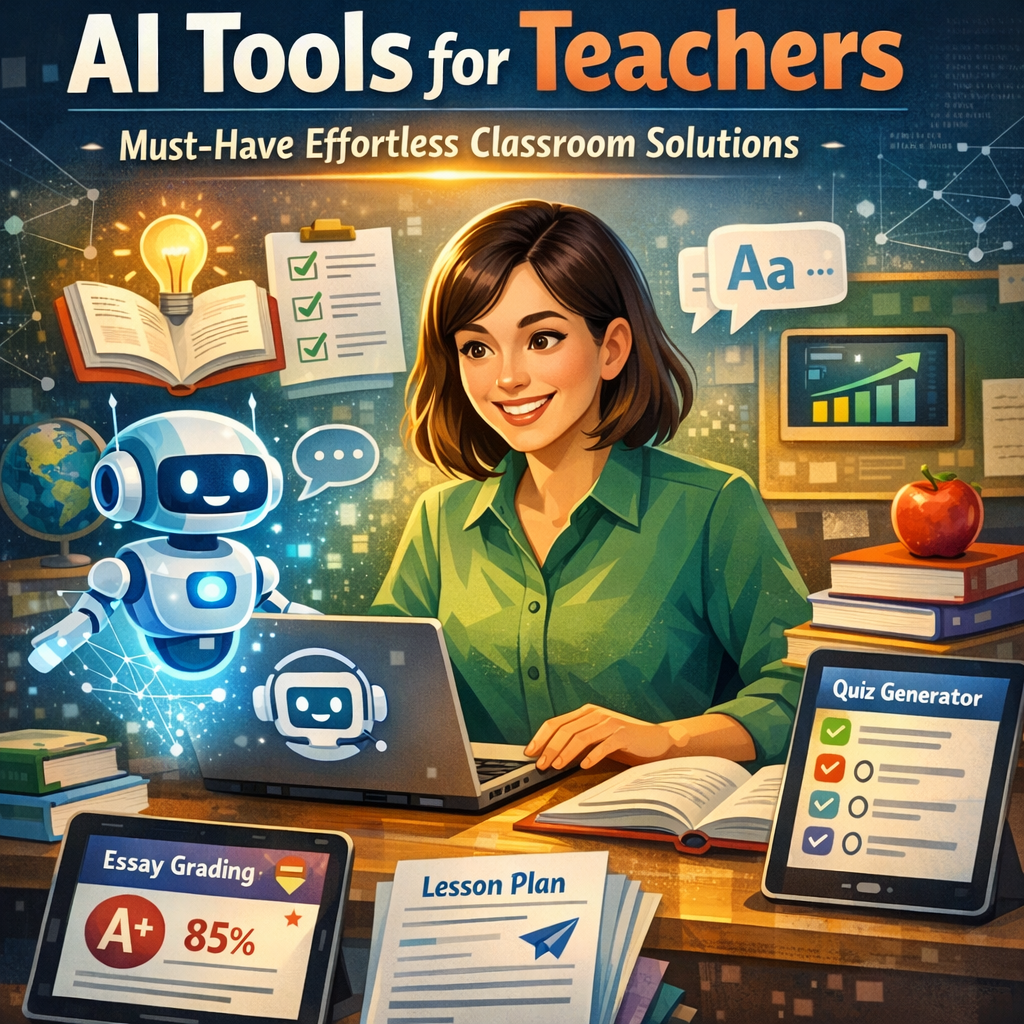
The biggest advantage of AI in the classroom is efficiency. Many teaching tasks are important but time-consuming: writing quizzes, creating rubrics, summarizing reading materials, differentiating assignments, and responding to routine emails. AI can help with all of these.
It also supports personalization. Students learn at different speeds and in different ways. Some need simplified explanations, while others thrive with extra challenge. AI makes it easier to adapt materials for a range of learners without requiring teachers to create every version from scratch.
Beyond efficiency and personalization, AI can also boost creativity. Teachers can use it to brainstorm project ideas, generate discussion prompts, create writing starters, or build interactive activities in minutes.
Must-Have AI Tools for Teachers
There is no single tool that solves every classroom need. The best approach is to choose tools based on the specific tasks you want to simplify. Here are some of the most useful categories.
AI Tools for Teachers for Lesson Planning
Lesson planning can take hours, especially when educators are trying to align activities with standards and meet diverse student needs. AI planning tools can generate lesson outlines, essential questions, warm-up activities, and extension tasks based on a topic or grade level.
These tools are especially helpful when:
– You need a quick first draft of a lesson
– You want multiple activity options for one topic
– You need to create differentiated materials
– You are planning for substitute teachers
The key benefit is speed. Instead of starting from a blank page, teachers can begin with AI-generated suggestions and then refine them to match their style, curriculum, and students.
AI Tools for Teachers for Assessment Creation
Creating assessments is another area where AI saves significant time. Teachers can use AI to draft:
– Multiple-choice quizzes
– Short-answer questions
– Exit tickets
– Vocabulary checks
– Writing prompts
– Rubrics
Some tools can even adjust the difficulty level of questions, making it easier to support both struggling learners and advanced students. This allows teachers to spend more time analyzing student understanding rather than building each assessment from the ground up.
Grading and Feedback Support
Feedback is one of the most powerful drivers of student growth, but writing detailed comments for every assignment can be exhausting. AI can assist by generating feedback suggestions, identifying common writing issues, or helping teachers create comment banks for repeated mistakes.
This does not mean every student response should be graded by a machine. Human judgment still matters. However, AI can speed up the process by helping teachers organize comments, spot patterns, and draft constructive responses that teachers can personalize.
Classroom Communication Made Easier
Teachers spend a surprising amount of time writing messages to parents, students, and colleagues. AI tools can help draft professional emails, newsletters, announcements, and reminders in a clear and respectful tone.
For example, a teacher might use AI to:
– Write a weekly classroom update
– Draft a parent conference summary
– Simplify an assignment explanation
– Translate communication for multilingual families
– Create behavior reflection forms
This is especially useful for busy educators who want communication to stay strong without adding more stress to their day.
Personalized Learning and Student Support
One of the most exciting uses of AI in education is its ability to support differentiated instruction. Teachers often need to adjust content for students with varying readiness levels, language abilities, or learning styles. AI can help transform one text into several versions—simplified, expanded, or summarized.
It can also generate:
– Practice questions tailored to skill level
– Reading passages on student-interest topics
– Guided notes
– Study reviews
– Step-by-step explanations
This helps teachers meet students where they are while maintaining learning goals. It also makes classrooms more inclusive by giving students multiple ways to engage with the same content.
Creative Uses of AI in Daily Teaching
AI is not just for productivity. It can also make learning more dynamic and engaging. Teachers are using AI to create:
– Debate topics
– Role-play scenarios
– Story starters
– Science experiment questions
– Historical interview simulations
– Visual prompts for writing
– Review games and classroom challenges
These creative applications can increase participation and curiosity. When students feel that lessons are fresh and interactive, they are often more motivated to contribute.
How to Use AI Responsibly in the Classroom
Although AI offers many benefits, it should be used carefully. Teachers should always review AI-generated content for accuracy, bias, and appropriateness. Not every suggestion will be classroom-ready, and some responses may need editing before use.
A few best practices include:
1. Always fact-check content before sharing it with students.
2. Protect student privacy by avoiding the input of sensitive personal information into public AI tools.
3. Use AI as a draft partner, not a final authority.
4. Be transparent about how tools are being used when appropriate.
5. Teach students critical thinking so they understand that AI outputs are not always perfect.
Responsible use ensures that technology enhances teaching without creating confusion or ethical problems.
Choosing the Right AI Tools for Teachers
With so many options available, it helps to start small. Instead of trying every new platform, identify one or two problem areas in your workflow. Do you need help with planning? Grading? Communication? Differentiation? Once you know your main pain point, it becomes much easier to choose a tool that genuinely helps.
When evaluating a platform, consider:
– Ease of use
– Data privacy policies
– Cost or free plan availability
– Compatibility with your existing systems
– Customization options
– Quality of outputs
The best tools are not necessarily the most advanced. They are the ones that fit naturally into your routine and save real time.
The Future of Teaching with AI
AI is likely to become a regular part of education, much like learning management systems and digital whiteboards already are. As these tools improve, teachers will have even more support for planning, differentiation, and student engagement. But the heart of education will remain deeply human.
Students still need encouragement, mentorship, empathy, and real connection—things no software can replace. AI can organize materials, generate ideas, and speed up repetitive tasks, but it cannot build trust the way a teacher can.
Used well, AI does not reduce the role of educators. It strengthens it. It allows teachers to spend less time on paperwork and more time on what truly matters: guiding students, building relationships, and creating meaningful learning experiences.
Final Thoughts
AI is not a magic solution, but it is a powerful one. For teachers juggling countless responsibilities, the right tools can make daily tasks feel more manageable and lessons more flexible. Whether you use AI to draft assessments, personalize materials, improve communication, or spark creativity, the goal is the same—to make teaching more effective and less overwhelming.
As classrooms continue to evolve, educators who embrace practical technology will be better positioned to adapt, innovate, and support every learner with confidence.