
AI HR Tools: 7 Must-Have Solutions for Effortless Hiring
AI HR tools are transforming the way companies attract, screen, and hire talent. What once required hours of manual effort, endless spreadsheets, and back-and-forth communication can now be handled faster and more accurately with smart automation. For hiring teams under pressure to fill roles quickly without sacrificing quality, these tools are no longer a nice-to-have—they are becoming essential.
The modern hiring process is full of challenges: large volumes of applications, difficulty identifying top candidates, scheduling delays, inconsistent communication, and the constant need to improve candidate experience. Artificial intelligence helps solve these pain points by streamlining repetitive tasks, highlighting the best matches, and giving recruiters more time to focus on relationship-building and decision-making.
Below are seven must-have solutions that can make hiring more efficient, organized, and effective.
Why AI Is Reshaping Recruitment
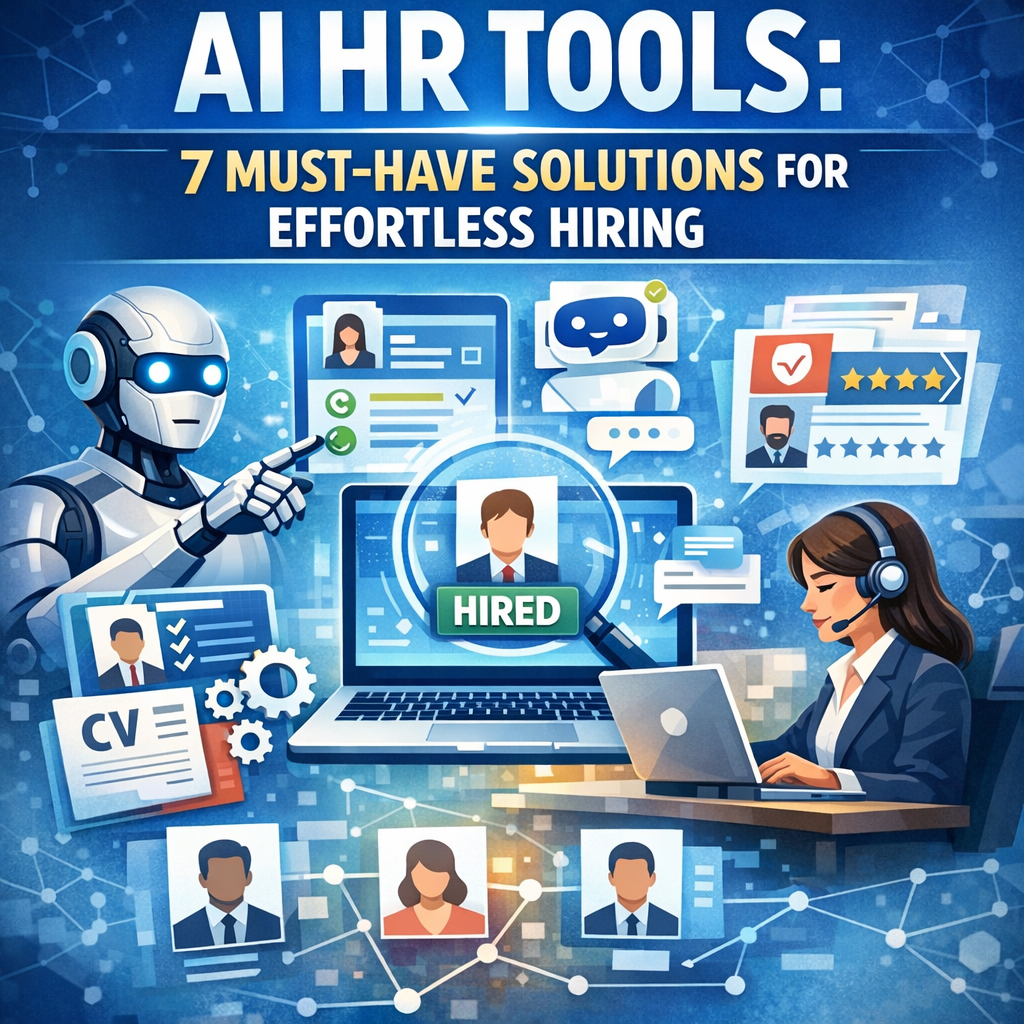
Recruitment has always been a balance between speed and accuracy. Move too slowly, and you lose top talent. Move too quickly, and you risk poor hiring decisions. AI helps close that gap.
These systems analyze data, automate workflows, and support recruiters at every stage of the hiring funnel. Instead of replacing human judgment, the best platforms enhance it. They reduce admin work, improve consistency, and make hiring processes more scalable—especially for growing businesses and busy HR teams.
1. AI HR Tools for Resume Screening
One of the most useful applications of AI in hiring is resume screening. Recruiters often spend hours reviewing applications, especially for high-volume roles. AI-powered screening tools can scan resumes in seconds, identify relevant qualifications, and rank candidates based on job fit.
These platforms typically look at experience, skills, education, certifications, and keyword alignment. More advanced tools can also evaluate contextual fit rather than simply matching exact phrases.
Key benefits:
– Reduces time spent reviewing resumes manually
– Surfaces strong candidates faster
– Improves consistency in shortlisting
– Helps recruiters focus on high-potential applicants
This is especially valuable when hundreds of applications come in for a single position.
2. Intelligent Candidate Sourcing Platforms
Finding quality talent is often harder than evaluating applicants. AI sourcing tools help recruiters discover passive and active candidates across multiple platforms, databases, and professional networks.
Instead of relying only on inbound applications, these systems identify profiles that match the role and can even recommend candidates based on past successful hires. Some tools also use predictive matching to uncover talent who may not be actively applying but fit the requirements well.
Why it matters:
– Expands the talent pool
– Reduces dependence on job boards alone
– Finds candidates with highly specific skills
– Speeds up outreach for difficult-to-fill roles
For companies competing in tight labor markets, AI-driven sourcing can create a major advantage.
3. Chatbots for Candidate Engagement
Strong candidates expect fast communication. Delayed replies, unclear application steps, and scheduling confusion can lead to drop-off. AI chatbots solve this by providing instant, always-on support throughout the recruitment process.
These chatbots can answer frequently asked questions, guide applicants through next steps, collect basic screening information, and keep candidates informed. They are particularly useful for high-volume recruitment and organizations hiring across multiple time zones.
Common chatbot functions:
– Answering questions about job roles
– Providing status updates
– Pre-screening applicants with basic questions
– Assisting with interview scheduling
The result is a smoother candidate experience and less administrative burden on HR teams.
4. Automated Interview Scheduling Tools
Interview scheduling sounds simple, but it often becomes one of the most frustrating parts of hiring. Coordinating calendars between recruiters, hiring managers, and candidates can create unnecessary delays.
AI-powered scheduling tools automate this process by checking availability, suggesting times, sending invites, and managing reschedules. Some platforms also handle time zone conversion and reminders automatically.
Advantages include:
– Faster interview coordination
– Fewer email chains
– Reduced scheduling errors
– Improved candidate convenience
By removing this bottleneck, recruiters can keep the process moving and reduce the risk of losing interested candidates.
5. AI-Powered Pre-Employment Assessments
Skills-based hiring is growing, and AI makes it easier to assess candidates fairly and efficiently. AI-driven assessment tools can evaluate technical ability, cognitive skills, language proficiency, job-specific knowledge, and even communication style through structured exercises.
These tools go beyond resumes by helping employers see whether someone can actually perform the work required. Some systems also adapt questions in real time based on candidate responses, creating a more personalized and accurate assessment process.
Best use cases:
– Technical hiring
– Customer service and sales roles
– Entry-level recruitment
– High-volume screening
When paired with structured evaluation criteria, assessments can improve quality-of-hire and reduce reliance on gut instinct alone.
6. Video Interview Analysis Solutions
Video interviews are now common, especially for remote and hybrid roles. AI-enhanced video interview platforms help standardize this stage by organizing responses, generating transcripts, and identifying patterns across interviews.
Some tools offer interview summaries, keyword analysis, and scoring support based on predefined competencies. This helps hiring teams review responses more efficiently and compare candidates more consistently.
Important note:
Companies should use these tools carefully and ethically. AI should support evaluation, not make unfair assumptions about personality, background, or communication style. Transparency and human review remain essential.
When used responsibly, video interview solutions can save time and create more structured hiring decisions.
7. Predictive Analytics for Hiring Decisions
Predictive analytics is one of the most strategic AI solutions in HR. These tools analyze historical hiring data, performance metrics, turnover patterns, and recruitment outcomes to help organizations make better decisions over time.
Instead of only helping with immediate tasks, predictive systems offer insights such as:
– Which sourcing channels bring in top performers
– Which roles are likely to be hardest to fill
– What factors may predict early turnover
– How long certain hiring stages typically take
This allows HR leaders to improve planning, allocate resources better, and refine their overall talent strategy.
How to Choose the Right AI Hiring Solution
Not every tool is right for every company. The best choice depends on your hiring volume, team size, budget, and existing tech stack. Before investing, it helps to ask a few practical questions:
– Which part of hiring takes the most time today?
– Do we need automation, better insights, or both?
– Will this tool integrate with our applicant tracking system?
– Does it support fair and compliant hiring practices?
– Will recruiters and hiring managers actually use it?
A good AI solution should simplify the process, not add complexity. Ease of use, transparency, and measurable value should all be part of the decision.
Final Thoughts
Hiring is becoming more data-driven, candidate-focused, and competitive. AI gives HR teams the ability to move faster while still making thoughtful, high-quality decisions. From sourcing and screening to scheduling and analytics, the right tools can remove friction at every stage of recruitment.
The strongest hiring strategies combine technology with human judgment. AI can handle repetitive tasks, uncover useful patterns, and support smarter workflows—but people still make the final call. When used well, these solutions do more than save time. They help build stronger teams with less effort and more confidence.