
AI A/B Testing Tools: Best Must-Have Solutions for Growth
AI A/B testing tools are changing how businesses optimize websites, ads, emails, landing pages, and product experiences. Instead of relying only on slow manual experiments and guesswork, teams can now use intelligent platforms to uncover patterns faster, predict outcomes more accurately, and personalize experiences at scale. For growth-focused brands, these solutions are no longer just “nice to have.” They are becoming essential for improving conversion rates, reducing wasted spend, and making better decisions with confidence.
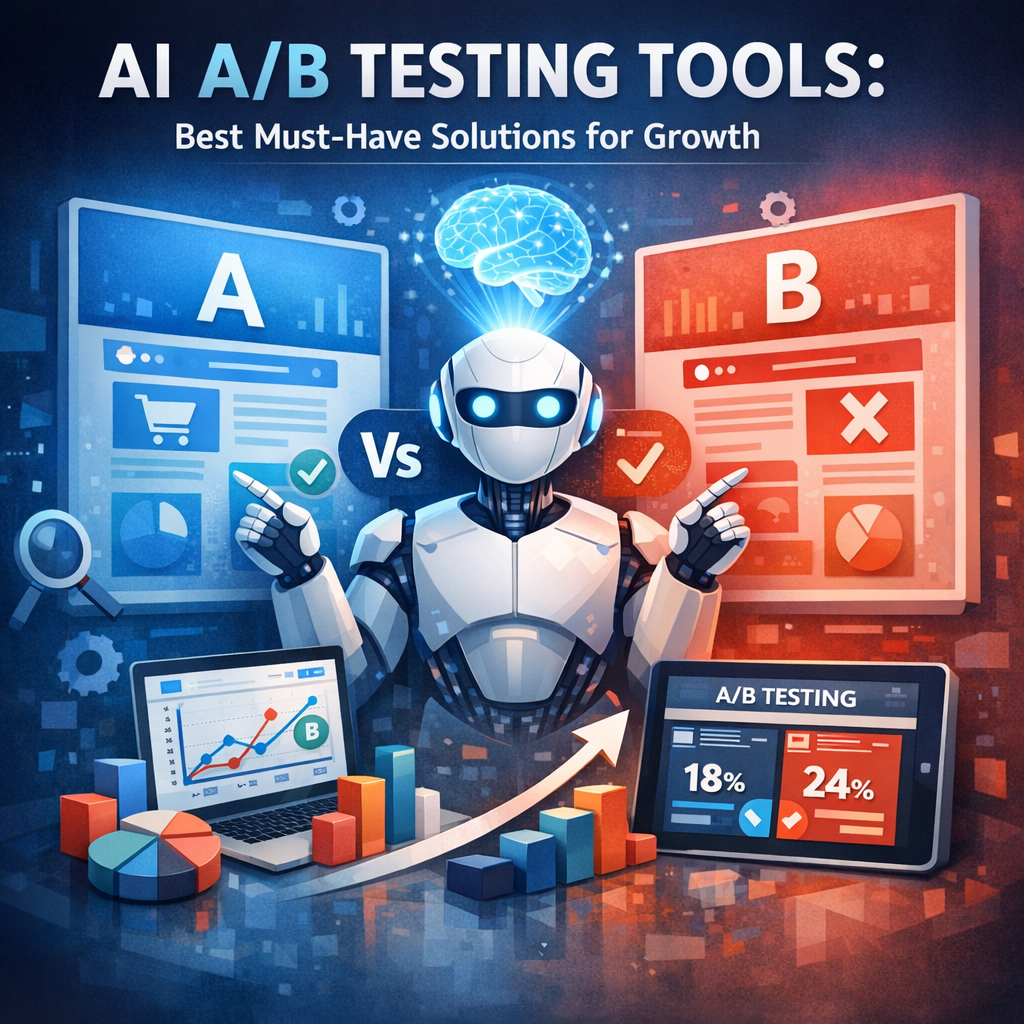
A/B testing has always been one of the most practical ways to improve performance. You create two or more versions of an asset, show them to different users, and measure which one works better. The challenge is that traditional testing can be time-consuming. It often requires constant monitoring, large sample sizes, and a lot of interpretation. AI helps solve these issues by automating analysis, identifying winning variations sooner, and even suggesting what to test next.
Why Modern Teams Need Smarter Experimentation
Growth today depends on speed. Markets shift quickly, user expectations evolve constantly, and competitors are always optimizing. If your testing process is slow, you risk making decisions based on outdated assumptions.
That is where AI-powered experimentation stands out. These tools can process large volumes of behavioral data, detect meaningful signals, and help teams prioritize the changes most likely to improve results. Instead of only telling you which version won, advanced platforms can explain why one version performed better and which audience segments responded most positively.
This matters for several reasons:
– Faster time to insight
– Better use of traffic and budget
– Improved personalization
– Stronger decision-making
– More efficient growth teams
For businesses trying to scale, smarter testing is directly tied to smarter growth.
What Makes AI A/B Testing Tools Valuable?
Not every platform labeled “AI-powered” delivers meaningful intelligence. The best solutions go beyond basic reporting and offer features that truly improve the experimentation process.
1. Automated insights
High-quality platforms do more than show lift percentages. They automatically surface patterns, anomalies, audience behaviors, and performance drivers.
2. Predictive analytics
Some tools estimate likely outcomes before a test fully matures. This can help teams act faster without waiting endlessly for data to accumulate.
3. Personalization capabilities
Rather than treating all users the same, smarter systems can adapt experiences based on device, behavior, location, referral source, or intent.
4. Multivariate and multi-armed bandit testing
These methods allow teams to test multiple elements or dynamically shift traffic toward better-performing variants while the experiment is still running.
5. Easy integrations
The best platforms connect with analytics suites, CRMs, ad platforms, ecommerce systems, product analytics tools, and customer data platforms.
6. Clear reporting for non-technical teams
A great testing solution should support marketers, product managers, designers, and executives—not only analysts and developers.
Best Must-Have Solutions for Growth
There is no single perfect platform for every company. The right choice depends on business size, technical resources, testing volume, and growth goals. However, several tools stand out as must-have options.
Optimizely
Optimizely remains one of the best-known experimentation platforms for enterprise teams. It offers robust A/B testing, feature experimentation, personalization, and advanced reporting. Its strength lies in supporting both marketing and product teams, making it ideal for organizations that want to experiment across the full customer journey.
Best for: Enterprises and mature growth teams
Strengths: Scalability, feature flags, experimentation depth
VWO
VWO is a strong option for companies looking for a balance between usability and sophistication. It supports A/B testing, split URL testing, multivariate testing, heatmaps, and behavior analytics. For teams that want optimization without an overly technical setup, VWO is often a practical choice.
Best for: Mid-sized businesses and conversion optimization teams
Strengths: User-friendly interface, visual testing tools, behavioral insights
AB Tasty
AB Tasty focuses on experimentation and personalization with a strong emphasis on customer experience. Its visual editor and targeting features make it useful for marketing teams that want to launch tests quickly. It also supports product recommendations and personalization strategies powered by data.
Best for: Brands focused on ecommerce and customer experience
Strengths: Personalization, segmentation, easy deployment
Adobe Target
Adobe Target is a powerful solution for large organizations already operating within the Adobe ecosystem. It combines testing, automation, and personalization in a highly advanced environment. Its AI capabilities are especially useful for audience targeting and delivering tailored experiences.
Best for: Enterprises using Adobe products
Strengths: Deep personalization, enterprise integrations, advanced targeting
Dynamic Yield
Dynamic Yield is widely recognized for personalization and experience optimization. It is especially valuable for ecommerce brands that want to customize product recommendations, messaging, and on-site experiences. Its testing capabilities work well alongside segmentation and recommendation engines.
Best for: Ecommerce and retail brands
Strengths: Personalization, recommendation engines, omnichannel optimization
Convert
Convert is known for being privacy-conscious and flexible. It offers solid experimentation functionality while emphasizing compliance and control. For companies that care about performance and data privacy, it can be a very attractive option.
Best for: Privacy-focused businesses and agile teams
Strengths: Compliance, reliability, strong testing framework
How to Choose the Right AI A/B Testing Tools
Selecting a platform should never be based only on popularity. The best fit depends on how your team works and what you are trying to achieve.
Here are some key questions to ask:
– Do you need website optimization, product experimentation, or both?
– Will marketers run tests independently, or will developers be involved?
– Do you need AI-driven personalization in addition to standard testing?
– How much traffic do you have available for experiments?
– Which analytics and CRM tools need to connect with the platform?
– Is compliance or data privacy a major concern?
– Do you need enterprise-level governance or a faster self-serve solution?
A smaller ecommerce brand may benefit more from a simple, fast platform with personalization built in. A SaaS company may need feature flags and product experimentation. A global enterprise may require tight integration with existing systems and advanced governance controls.
Common Mistakes to Avoid
Even the best tools cannot fix a poor experimentation strategy. Many teams invest in technology but still fail to see strong results because they approach testing the wrong way.
Some common mistakes include:
– Testing without a clear hypothesis
– Ending tests too early
– Ignoring audience segments
– Focusing only on clicks instead of business outcomes
– Running too many low-impact experiments
– Using AI recommendations without human review
AI should support strategic thinking, not replace it. Human judgment is still necessary to understand context, brand goals, and customer psychology.
The Future of Growth Optimization
Experimentation is moving beyond simple winner-versus-loser comparisons. The future is more adaptive, more personalized, and more automated. AI is helping teams shift from reactive testing to proactive optimization. Instead of asking only, “Which version performs better?” businesses can now ask, “What experience should each user see for the highest likelihood of conversion?”
That shift is powerful. It means growth teams can spend less time digging through data and more time acting on insights. It also means businesses can deliver experiences that feel more relevant, timely, and valuable to their audiences.
Final Thoughts
For companies serious about growth, investing in smarter experimentation is one of the most effective ways to improve performance. The right platform can help uncover opportunities faster, reduce manual analysis, and support better decisions across marketing, product, and customer experience.
Whether you choose Optimizely, VWO, AB Tasty, Adobe Target, Dynamic Yield, or Convert, the key is to pair the technology with a disciplined testing strategy. When used well, AI-powered experimentation tools can become a major competitive advantage—helping brands move faster, learn more, and grow with greater precision.